The examples on the previous page may sound simplistic – “of course those people are feeling symptoms in response to stress!” But very often, what is easy to identify in other people is hard to recognize in ourselves: we have a hard time identifying how much stress and tension we carry in our bodies because of our life experiences. We may become used to the idea that our lives aren’t so bad, and that other people have it worse, so we can’t possibly be feeling anything physical related to stress. Instead, we often look for medical advice and a diagnosis when we are plagued with pain.
When medical tests don’t find a specific cause for physical symptoms, patients are often left in an uncomfortable position. On the one hand, they are told, “Don’t worry, there’s nothing wrong with you.” But on the other hand, they are still left with very uncomfortable and worrisome symptoms that can interfere with their daily lives!
To make things more complicated, sometimes certain findings on an x-ray or MRI scan have very little to do with the physical symptoms that people experience. For example, did you know that a huge number of people without any back painhave evidence of “bulging discs” or “disc herniation” on MRI scans? The following chart illustrates how common these features are as we get older.
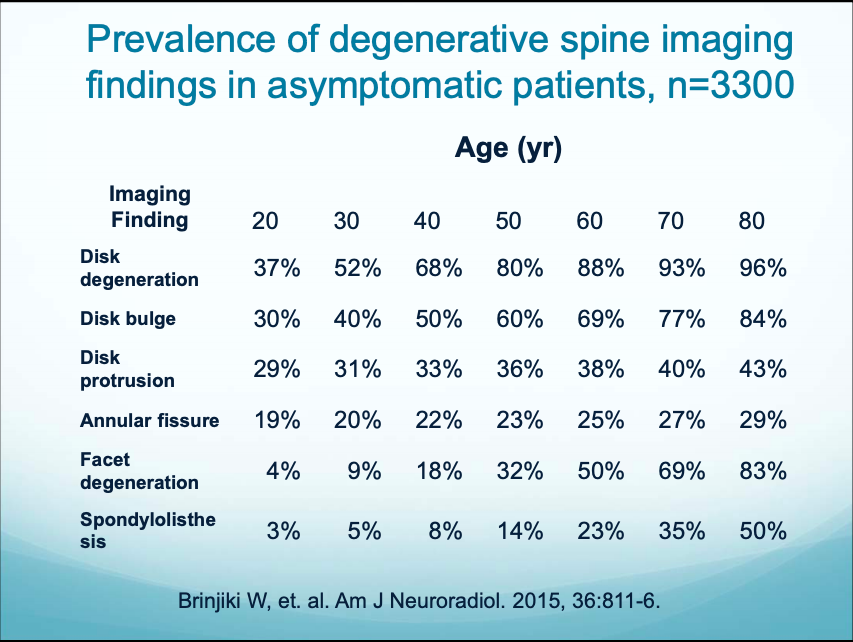
If so many people can be walking around without even knowing that they have these “problems,” could it be possible that maybe these findings are actually not the cause of the pain?
American physician Dr. John Sarno recognized that many of his patients’ back problems improved when they recognized the emotions that were hiding in their subconscious and gave them a voice. Thousands of people swear by his methods, and while they don’t work for everyone, or for every chronic pain condition, they are a clear example of the power that emotions can have on our physical health. (More about Dr. Sarno can be found here.)
How does the mind cause pain and other symptoms?
The first thing to note is that pain is painful, no matter whether it’s caused by an acute injury (like a broken leg) or chronic stress (like disabling migraine headaches). You should neverbe made to feel that pain is made-up, fake, or just imagined. Anyone who makes you feel that the pain is imaginary, or that you somehow want these symptoms, is either cruel or ignorant or both. (Sadly, many physicians do just this when faced with symptoms they can’t explain.)
Secondly, pain created by the brain can co-exist with pain created elsewhere in the body. People who have painful inflammatory conditions, like rheumatoid arthritis or Crohn’s disease, can also have pain that is either created or amplified by the brain.
Experts believe that the brain can create pain and other symptoms through several mechanisms. Here are several ways that our brains can affect our bodily sensations:
- Learned neural circuit activation: when pain circuits in the brain are activated due to an injury, the same pain circuits can be reactivated in the future even when the physical damage of the injury has resolved – think of it as a “pain memory” or a “pain echo.”
- Direct activation of the nerves that control our organs, blood vessels, and muscles: our brain can cause almost any organ to function differently. If a message is sent to our intestines to speed up their movement, it can cause cramping and diarrhea; if a message is sent to the blood vessels in our head to change how much blood is passing through, we can end up with a migraine. Decreased blood flow to our muscles can cause achiness and pain, almost as if we had done an intensive workout!
For more detailed information on mind/body connections that can explain chronic pain and other symptoms, please have a look at the videos linked below: